
Published on March 27, 2025 by Ashley Rothstein animal based pregnancy
animal based pregnancy
Hey mama! If you’re new here, welcome.
I’m pregnant with baby #2 (31 weeks as I write this post – it’s another girl!) and this is my second animal-based pregnancy.
I have a comprehensive blog post on what I ate, took, and did to fuel me and my first baby during pregnancy, so if you haven’t seen that post yet, I highly recommend you start there: Animal-Based Pregnancy: What I Ate, Took & Did to Fuel Me and My Baby.
This second pregnancy has been much different than the first. animal based pregnancy
I recently wrote two blog posts on the conception journey for this second babe and the first trimester of my second pregnancy. Both elaborate on what I mean by “different.” If you’d like to learn more, check them out.
In a nutshell, being pregnant while caring for a toddler full-time (and under a lot of personal stress) is a whole different ballgame.
My stress levels this time around feel sky high, and while my symptoms are similar to my first pregnancy, everything feels extremely exacerbated.
Not only that, but round-the-clock toddler care gives me little space to cope and rest, so I haven’t been even close to as methodical as I was during my first pregnancy when it comes to supplement routines, diversity in my diet, resting, reading, movement, etc.
I’ve been in survival mode pretty much the entire time with small pockets where I’ve been able to breathe, assess, plan, and regroup.
That being said, there’s still a lot I learned, and when I look back now, I am grateful for the journey and all that I’ve been able to do to keep up my nutrition, movement, and self-care despite my circumstances.
In this post, I’m going to go over what I’ve done this pregnancy in a highly stressed state to care for myself and grow this new babe as optimally as I could.

Heart & Soil Films featured our story in their mini-documentary, Nourished, which spotlights animal-based pregnancies. Click on the above image to watch it on YouTube.
How this post will be different than the first
In the blog post I wrote about my first pregnancy, I broke it up into four sections:
- First trimester (start of pregnancy – 13 weeks)
- Second trimester (13 weeks – 28 weeks)
- Third trimester (28 weeks – birth)
- Labor prep (36 weeks – birth)
In each section, I shared how I ate, the supplements I took, my thoughts around the tests I took/declined, reflections, and other things I felt were useful for that specific phase in my pregnancy.
For this pregnancy, I did things way simpler than my first. So instead of breaking this blog post up into sections by trimester, I broke it up into the following general sections:
- Diet
- Supplementation
- Autonomous pregnancy
- Testing
- Minimizing toxic products
- Remedies for common pregnancy ailments (plus new ones I dealt with this go around)
- Gender reflections
- Fetal movement
- Weight loss/gain
- Stretch marks
- Labor prep
- Books
- Body work
- Pelvic floor
- General movement
- Rh- thoughts
If you’d like to read about my first trimester experiences specifically, check out these blog posts here:
- Pregnancy #1: Getting Through The First Trimester On An Animal-Based Diet
- Pregnancy #2: Pregnancy #2 First Trimester: How I Got Through A Rough Season
I have blog posts on both conception journeys as well:
- Pregnancy #1: Our Fertility Journey: Conceiving On An Animal-Based Diet
- Pregnancy #2: Conceiving Baby #2: A Much Different Story This Time Around
I also have multiple story highlights on my Instagram page from this pregnancy (most recent pregnancy highlights) and my previous pregnancy (Pregnancy, Pregnancy 2, Pregnancy 3, Pregnancy 4) that I recommend checking out for meal ideas, pregnancy reflections, and other information too.
And lastly, for more animal-based pregnancy, birth, postpartum, and motherhood resources, check out my Pregnancy hub.
Okay, lets get to it.
Diet
I shared the below information in the blog post about my first trimester. It really hasn’t changed much, so I’m going to share it again here.
Even at this point in my pregnancy (31 weeks), eating and taking supplements are still pretty rough for me.
Due to the combination of my high stress levels over the past 15+ months, chronic sleep deprivation, and the hormonal fluctuations of pregnancy, I feel highly sensitive to many foods/supplements and even many non-food things (like car rides, socializing, screens, noise, etc.).
I am almost never hungry, still basically force-feed myself throughout the day (like I had to do during my first trimester) to get my nutrients in, and pretty much my entire pregnancy, I’ve only been able to eat about 7-10 foods.
I rarely look forward to my food (unfortunately – this makes me sad – since food used to bring me so much joy), and if you’ve gone through any of my previous pregnancy resources, you know this is nothing like my first pregnancy was.
During my first pregnancy, I was often excited to eat (second trimester and on) and loved/devoured fruit, raw cheese, and raw milk ice cream on repeat.
I also loved making bowls – like chicken thighs, apples, squash, and raw cheese topped with maple mustard or shredded pork, plantains, cilantro, squash, and lime.
I loved posting my meals because I was so excited to create them. I wish things were the same this go around, but as I mentioned above, I am still largely in survival mode.
That being said, I feel empowered by how far I’ve come and what I’ve done despite feeling so lousy and having to be so restrictive. I’ve been able to maintain 1800-2300+ calorie days every day of my pregnancy (even in the first trimester), and I usually land around 120-130g protein (80-110g protein during my first trimester), 150-250g carbs, and 90-100g fat per day.
This has recently increased a bit in my third trimester. I’m hitting 120-150g protein most days along with 200-250g carbs. Fat still lands around the same, and I usually come in at about 2200-2500 calories per day.
I was drinking/eating a ton of raw dairy during my first trimester, but I am sad to report that I had to give it up because I’m pretty sure I feel better without it.
The foods I currently eat are:
- beef
- chicken
- egg yolks
- apples in two forms (juice, fruit)
- ghee
- squash
- potatoes
- grapes
During my first trimester, I also ate oatmeal, applesauce, and maple syrup. I occasionally add in another food for a meal or two to increase diversity – like a banana, cucumber, avocado, blueberries, or another random fruit – but I almost always stick to my core foods.
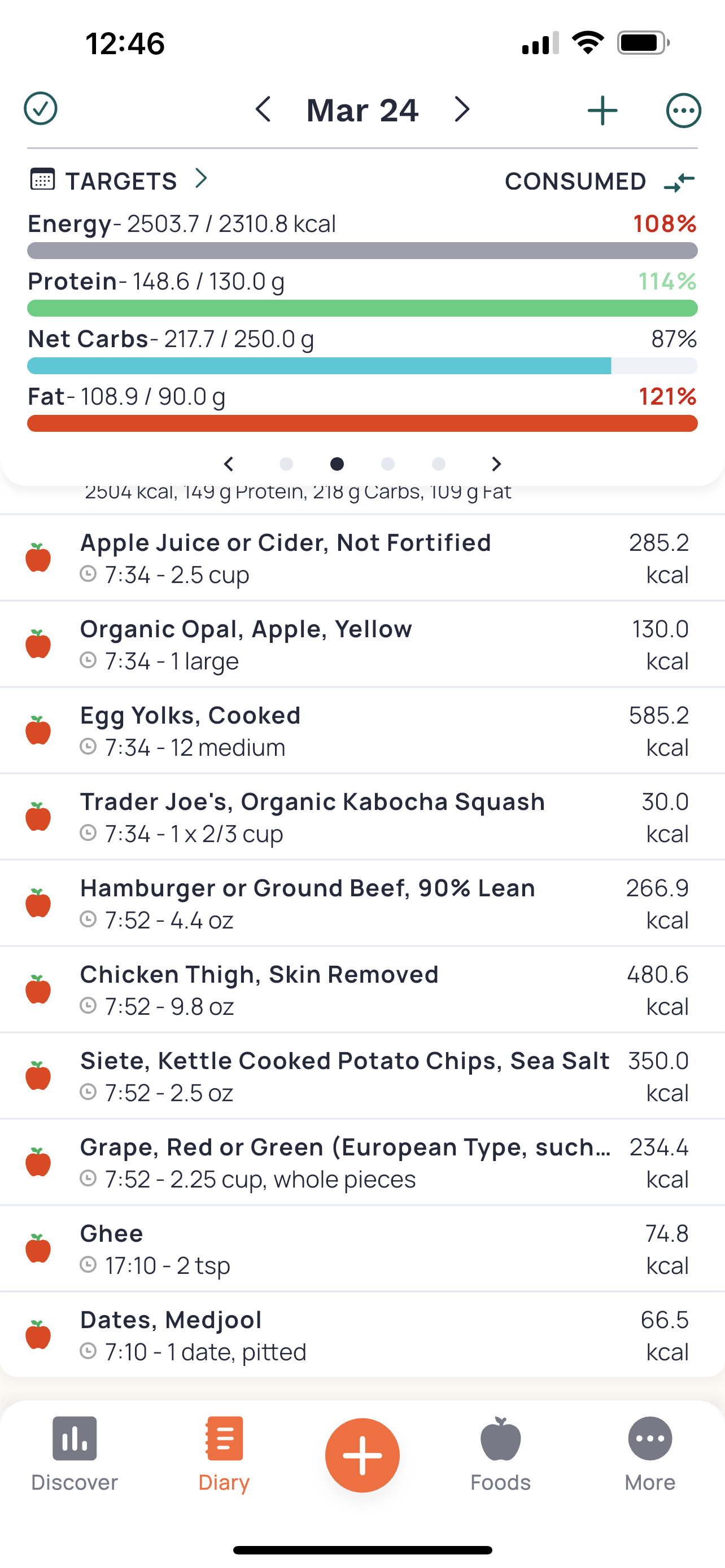
Since the beginning of pregnancy, I’ve been tracking my food in Cronometer to make sure I’m hitting my micros and macros (check my most recent pregnancy highlights if you want to learn more about this).
Here is a sample day:
During my first pregnancy, I did some research on pregnancy diet philosophies and was drawn to two – The Brewer Pregnancy Diet and the Weston A. Price Diet for Pregnant and Nursing Mothers. I took what resonated from each and made my own template.
- Brewer Pregnancy Diet: I included all sections except for grains, calcium replacements, and green vegetables. For milk products, I drank raw milk (32 oz+/day). For the protein section, I ate meat and raw cheese. And for the other sections, I chose animal-based fruits (usually strawberries, oranges, and squash). I occasionally ate sweet potatoes too.
- Weston A. Price Diet for Pregnant and Nursing Mothers: I didn’t take cod liver oil (the notice at the bottom of the page freaked me out), but I followed the list of recommended foods almost to a T. I went back and forth between collagen and bone broth as bone broth sometimes upsets my stomach. I ate ghee instead of butter and I didn’t do coconut oil.
- Note: Real Food for Pregnancy by Lily Nichols and The Nourishing Traditions Book of Baby & Child Care by Sally Fallon Morell & Thomas S. Cowan are also great pregnancy diet resources.
I did the best I could this pregnancy to follow the above guidelines/structure I set for myself last time, but there are some foods I just haven’t been able to do (liver, bone both, collagen, and raw dairy, for example), so, while tough, I just try to give myself grace.
Below is what a typical day looked like (and still looks like) for me in my second and third trimesters.
Fluids:
Note: fluids are still rough for me to stomach, so I do what I can and pay attention to urine color.
- 50-60+ oz salted water (read more about salted water here and here)
- 1 ampoule Quinton minerals (hypertonic) 5+ days per week
- Baking soda water, as needed (read more about that here)
- 40-50 oz diluted apple juice (50/50 water/apple juice)
Food:
Right now, I eat my first meal at about 5am and my last meal at about 5pm, and I eat every 2-2.5 hours in between.
My GI motility feels very slow these days, and with baby getting bigger and my organs smushed, it sucks to have to eat so often.
But my stomach still doesn’t feel great when it starts to empty, so the frequent eating is a must.
Here’s what a typical day looks like:
Meal 1, around 5am:
- 4 egg yolks + 1 Opal apple
Meal 2, split into two, eaten around 8am and 10:30am:
- 4-4.5 oz ground beef
- 3 egg yolks
- 1-1.5 cups kabocha squash
- 1-1.5oz Siete sea salt potato chips (random, ha, but these help my stomach a lot)
Meal 3, split into two, eaten around 12pm and 2:30pm:
- 6-7 oz chicken thighs
- 3 egg yolks
- 1 cup grapes
- 1-1.5 oz Siete sea salt potato chips
Meal 4, eaten around 5pm:
- 3-3.5 oz chicken thighs
- 2-3 egg yolks
- 1 cup grapes
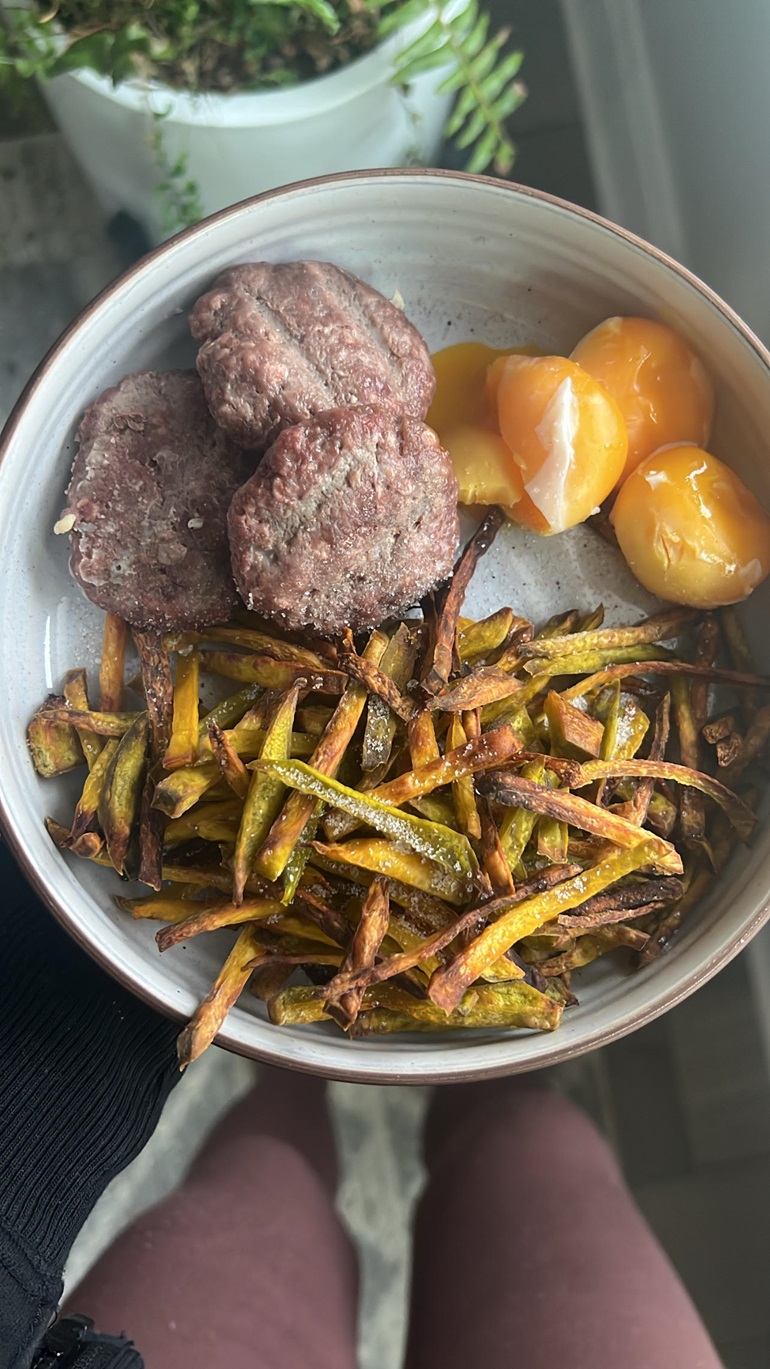
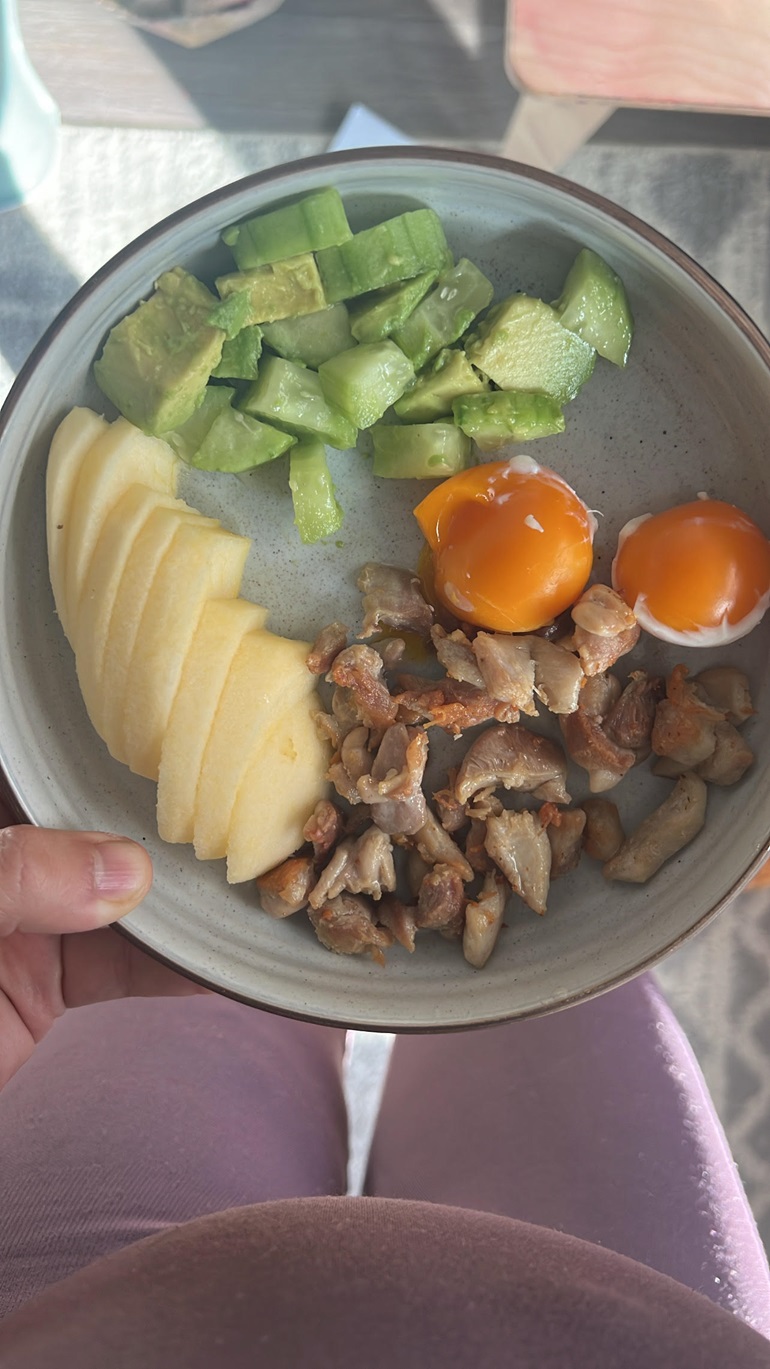
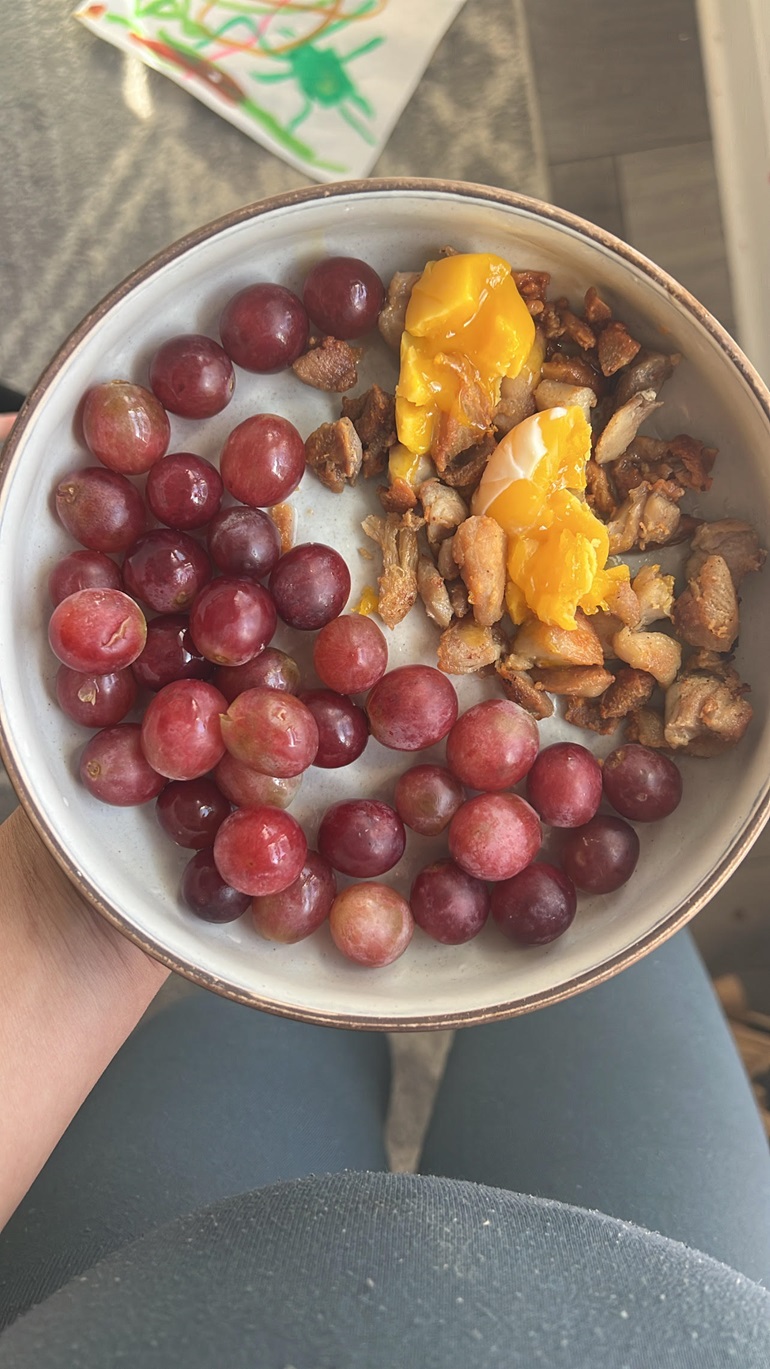
Here’s what my meals usually look like:
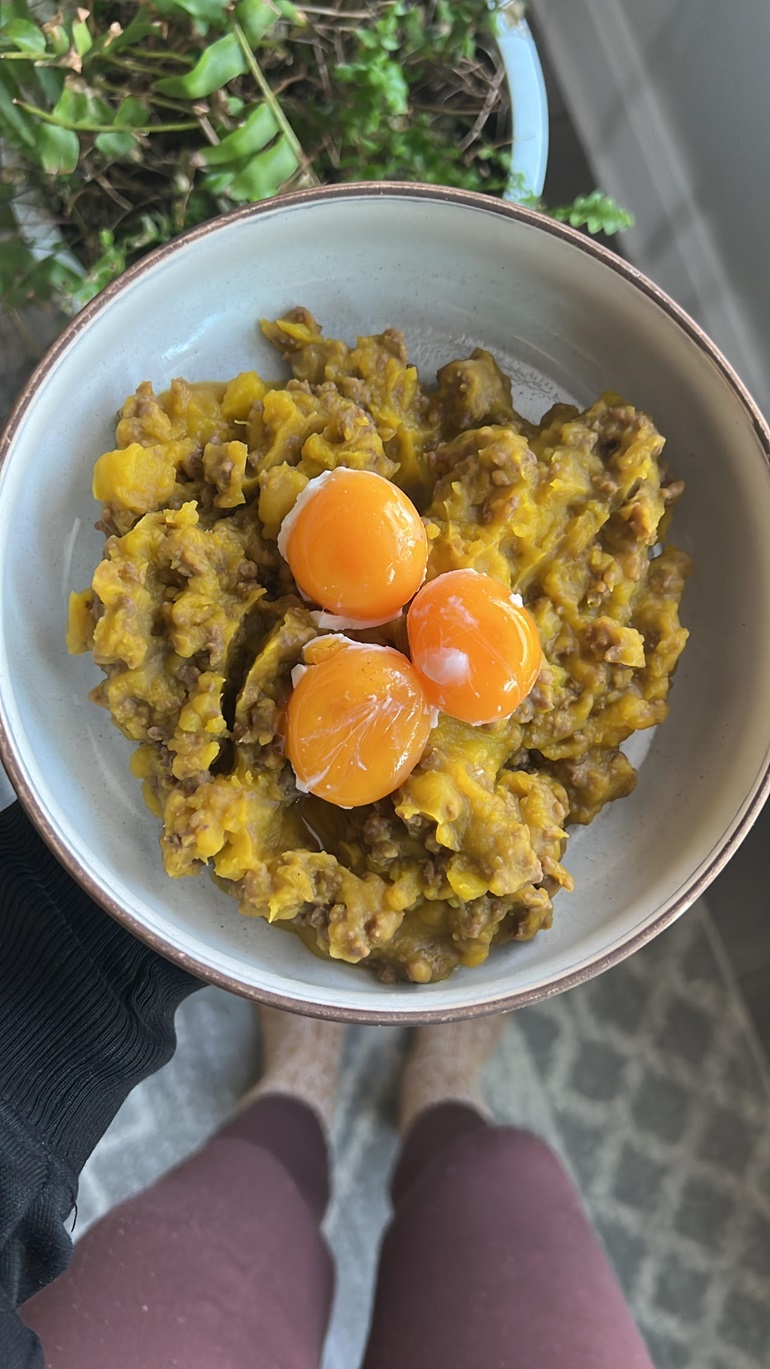
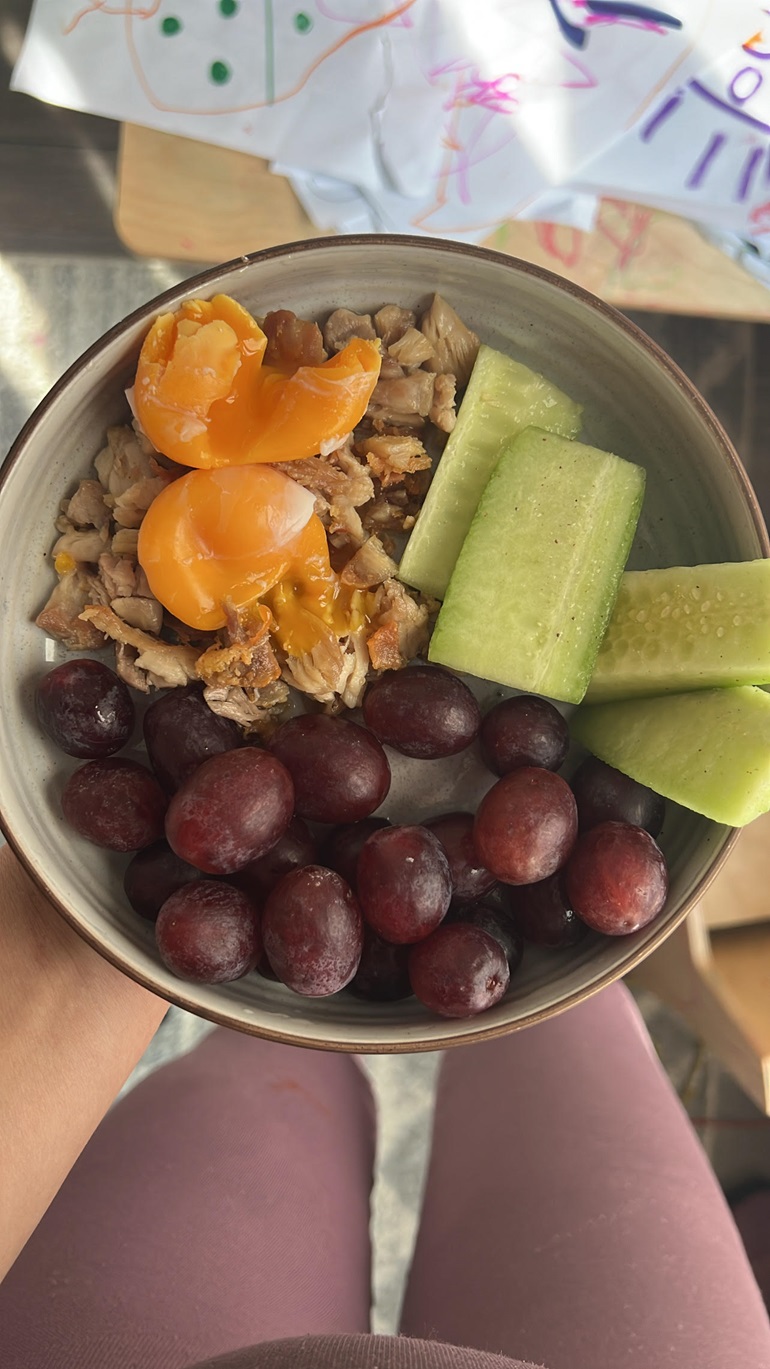
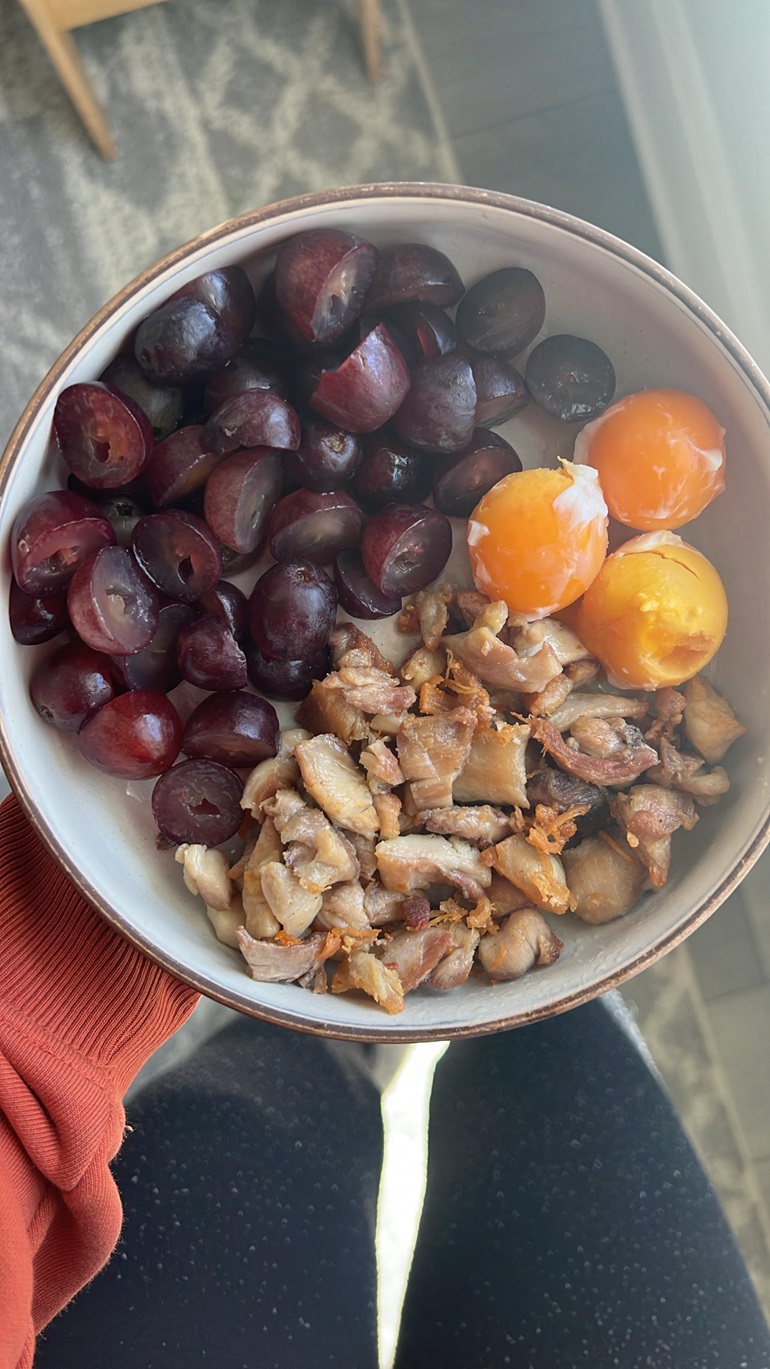
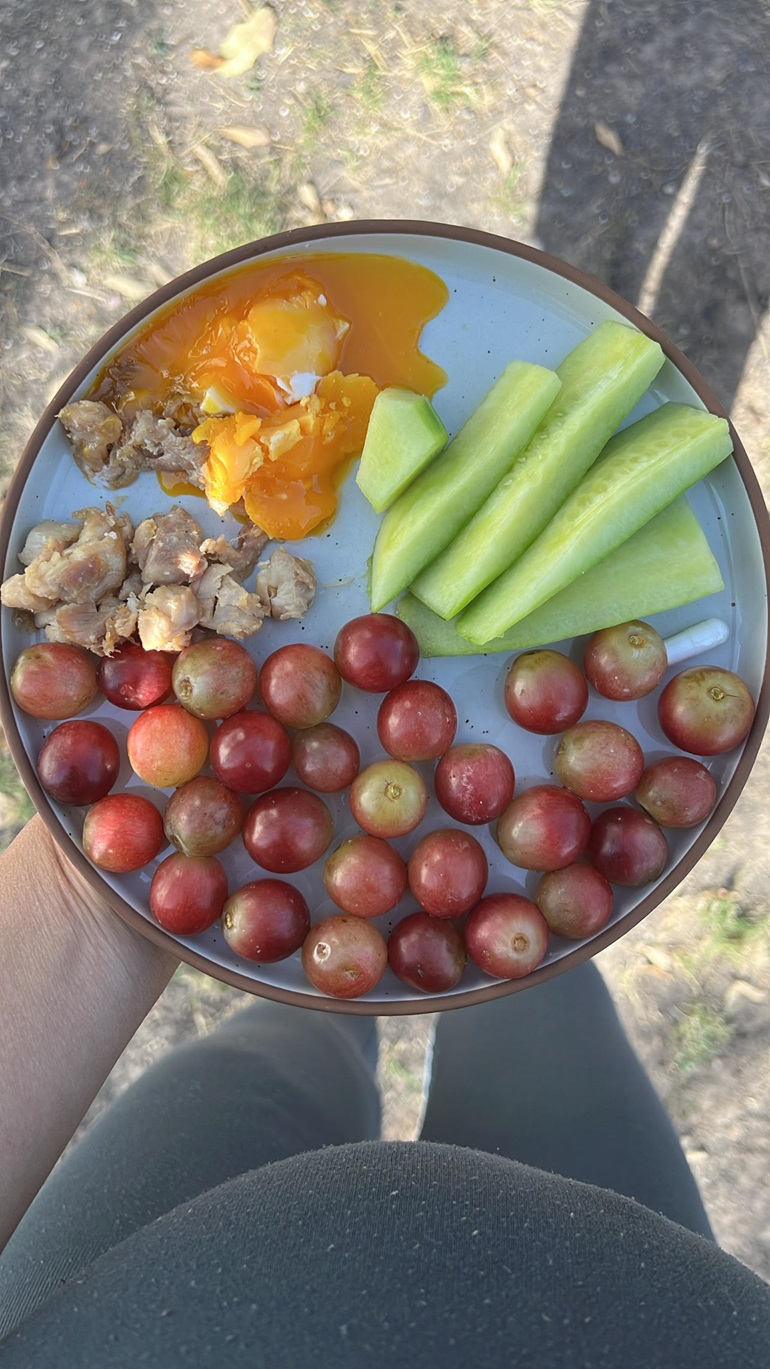
Why just egg yolks?
I crave scrambled eggs (so, the whole egg) a lot, but I seem to be quite sensitive to the whites these days.
I tried eating scrambled eggs a few times during my first and second trimesters, and it never went over well.
In fact, the last time I threw up this pregnancy was around 20 weeks (and after about a month of not throwing up). It was the day after I said, “f it, I’m just going to have scrambled eggs.”
Maybe it was a coincidence, but I’ve just stuck to yolks since then.
To my knowledge, the yolks are more nutrient-dense compared to the whites.
And eggs, in general, are an important food to eat during pregnancy. Both the Weston A. Price Diet for Pregnant and Nursing Mothers and The Brewer Pregnancy Diet recommend 2+ per day, and Weston A. Price recommends even more yolks.
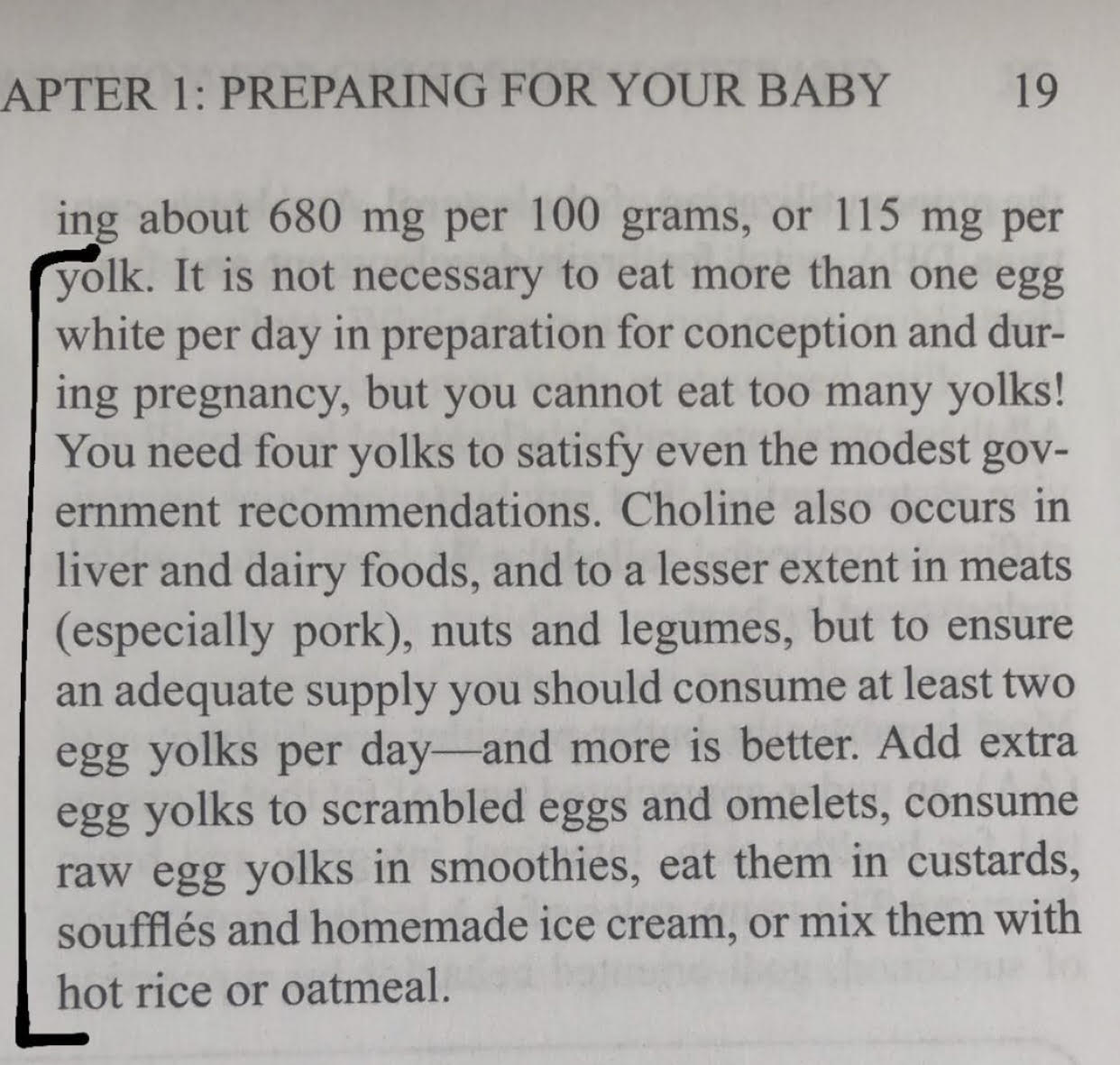
Excerpt from The Nourishing Traditions Book of Baby & Child Care by Sally Fallon Morell and Thomas S. Cowan, MD
I’m eating about 12-14 yolks per day at this point (ha), so I’m definitely covered in the yolk department. animal based pregnancy
Supplementation
During my first pregnancy, I was so intentional and regimented with my supplement routine. You’ll see this if you read the blog post I wrote on my first pregnancy.
I took what I learned from that pregnancy and used the same guideline I created for myself, but due to my sensitivities to food, I was all over the place when it came to structure.
Sometimes weeks went by without taking any supplements.
As I mentioned above, I track my food in Cronometer to make sure I’m hitting my micros and macros. And despite how restrictive my diet is, surprisingly, I’m usually not too far off from hitting all of my targets with my food alone. Yay for nutrient-dense animal foods.
I’m usually low-ish in folate, vitamin C, calcium, iron, omega 3’s and B1 (and by low-ish, I mean I hit about 50-75% of my target daily), but with the intermittent supplementation and the minerals/electrolytes I also consume, I just trust that my body is getting enough and that the micros will balance over time.
Note: I haven’t taken a prenatal and don’t intend to (nor did I take a prenatal during my first pregnancy).
Here’s a list of what I supplemented with throughout my first trimester (and still do when I feel up to it):
- Desiccated acerola cherries for vitamin C (ASHLEYR for 10% off)
- Heart & Soil Lifeblood for extra iron (ASH10 for 10% off)
- Eggshell powder for calcium (since I had to give up raw dairy in my first trimester)
- Shilajit for extra minerals
- Histamine Digest to help my body process histamine
- Sea salt capsules for extra sodium
- Homeopathic cell salts + other constitutional remedies (Sepia, Cocculus)
- Magnesium glycinate at night
- Quinton minerals
- LMNT for electrolytes
I am still working toward taking cod liver oil, desiccated oysters (ASHLEYR for 10% off), and desiccated cod roe (15% off with link) since I don’t eat fish. I have them all on hand…my brain just can’t stomach them yet.
Shockingly, I’ve had nearly zero liver this pregnancy (as opposed to the loads of liver I had my last pregnancy). It’s another thing my brain just can’t seem to stomach, and I also stay away from it due to it’s high histamine content.
I may try some soon, but I get a decent amount of folate from the egg yolks I eat.
I also took a methylated folate supplement for three months prior to conceiving and tested my levels at 4.5 weeks pregnant. They were great, and there were no signs of neural tube defects on our anatomy scan at 22 weeks, so I haven’t been too concerned about it.
Autonomous pregnancy
I had a horrible experience with the first midwife I hired for my first pregnancy (that ended up in a legal battle).
Thankfully, I ended up switching to another (God-sent) midwife around 30 weeks and ended up birthing with her.
I write more about this (high level) in the blog post about my first pregnancy.
Finding a provider whom you trust and align with is so, so, so important.
My wonderful midwife unfortunately moved out of state, so I had to find a new midwife for this pregnancy.
The whole debacle last time made me super sensitive to the idea of choosing a midwife, so weeks went by without me having a provider.
Thankfully, I found another gal who deeply supports physiological birth.
She was also okay with me doing an autonomous pregnancy model (very similar to what I did with my second midwife last time), which is what I wanted.
In a nutshell, we have just a few prenatal appointments, she will be there for me at my birth, and we will have two post-birth appointments. I am also monitoring my blood pressure and urine dip sticks at home (although she doesn’t even recommend urine dip sticks, I just do them on my own accord).
Here’s the structure that I’ve followed this pregnancy so far (and plan to follow). I’ve loved it!
- Pregnancy tests at home at around 4 weeks to confirm the pregnancy
- Dating ultrasound at 8.5 weeks (didn’t need a provider for this) for a more concrete confirmation of pregnancy
- First midwife appointment at 16 weeks (we talked, I heard baby on the doppler, got my uterus measured, and checked baby’s positioning – simple/low stress)
- Anatomy scan at 22 weeks (didn’t need a provider for this)
- Second midwife appointment at 28 weeks (we talked, I heard baby on the doppler, got my uterus measured, and checked baby’s positioning – simple/low stress)
- Third midwife appointment at 36 weeks (home visit)
- Birth
- Two postpartum visits
I’ve really enjoyed this because while I love the idea of a wild pregnancy, having some intermittent check-ins for validation (ultrasounds, doppler, and positional checks) relieves anxiety for me, but also doesn’t feed the need for ongoing validation.
It feels good, like a nice middle point.
So with this set up, I had/have a validation point every 6-8 weeks or so, which feels like the perfect amount of time. Not too often but frequent enough. animal based pregnancy
Testing
This pregnancy, I opted for almost no testing.
Here’s what I decided to do:
- Full blood panel around 4.5 weeks (I did this on my own before even hiring a midwife; I write more about it in this post here; also, check out this post to learn about how you can choose your own panel and test any lab marker you want without doctor referral – this is what I did)
- Dating ultrasound (I did this around 8.5 weeks, all was good)
- Anatomy scan ultrasound (I did this around 22 weeks, all was good)
- Monitoring my blood pressure at home
- Urine dip sticks at home
I didn’t do a crazy amount of testing my last pregnancy, but I did do the dating ultrasound too early.
In result, I ended up doing two extra ultrasounds since they couldn’t find the heartbeat at the first appointment, along with getting another one at 10 weeks (due to anxiety stemming from not being able to hear my daughter’s heartbeat on the doppler at my 10-week appointment).
I also followed my midwife’s advice during the first half of my first pregnancy to get some blood work done and monitor my blood pressure/urine dip sticks in-office.
After going through the prenatal process of my first pregnancy, it felt better to me this time to just stick to the two ultrasounds (which is why I waited until 8.5 weeks for the dating one), monitor my blood pressure/urine at home, and skip everything else.
I just trust that my body is getting what it needs and will be fine, and less testing feels good to me.
To learn more about why I declined all other testing this pregnancy and my first, check out this post. animal based pregnancy
Minimizing toxic products
I wasn’t super conscious of this while I was pregnant with my first daughter, but over the past few years, I’ve worked hard to eliminate toxic products in our home.
Minimizing toxic exposure is very important for fertility and pregnancy.
I have product guides available now that I created to help people source nutrient-dense food and replace conventional products with lower-toxic alternatives.
Check them out here, if interested. (They’re all free.)
Remedies for common pregnancy ailments
I have a list of the ailments I experienced during my first pregnancy and how I remedied them in this blog post.
My core symptoms this pregnancy (that I also experienced my first pregnancy) have been:
- Nausea
- Emotional fluctuations
- Insomnia
- Slow GI motility
And occasionally:
- Constipation
- SI joint pain
- Cold feet with bluish toes
- Peeing a lot
- Pelvic floor symptoms
I remedied the above symptoms with the knowledge from last time, and generally speaking, the symptoms usually improved or resolved.
Here are some new symptoms that have been unique to this pregnancy:
- Intense reflux
- Vomiting and gagging
- Dysgeusia
- Severe mood instability
- Crippling insomnia
I write about how I remedied some of the new symptoms in my first trimester post, but I must say….some of them I haven’t figured out and still live with.
Pregnancy is a wild, sacrificial time. And I think for some things, the only remedy is the passage of time and acceptance. animal based pregnancy
Gender reflections
I was convinced that my first daughter was a boy. I think I just wanted a boy so badly that I pretended my intuition was telling me it was a boy.
If you’d like, you can read more here about the 48-hour tantrum I had when I found out my first baby was a girl. 🙂
Interestingly enough, before this round of of conception, I had two dreams that this baby was going to be a boy. So, of course, I was convinced we would have a little boy.
We did the Sneak Peek gender test at 6 weeks, and lo and behold, the results came back that we were having another girl. The gender was also confirmed at our anatomy scan – our tech said she could clearly see that it was a girl.
At first, I was a bit in shock since I swore I was having a boy, but I’ve really grown into my “girl mom” role with my daughter.
So after a few moments of being ever so slightly bummed (I think it’s natural to desire the experience of parenting both genders), I became super excited to give my daughter a sister and to be the mom of two little girls.
And while I would still love a boy in the future, I also wouldn’t mind having all girls.
Funny how the tables turn.
All this to say…there was no tantrum about the gender this time around. 🙂
I am excited to have another little girl! animal based pregnancy
Fetal movement
With my first daughter, I felt her first movements around 17-18 weeks, and they were very faint at the start. For this baby, I felt fetal movement earlier.
I swear I felt some movements around 12/13/14 weeks, but I wasn’t sure. Gradually they became more consistent, probably around 15-16 weeks.
With my first daughter, I had a posterior placenta. With this gal, I have an anterior placenta.
Here’s what’s crazy…
With an anterior placenta, you’re technically supposed to feel baby’s movements less.
My first daughter was super active in my womb, but this new one is a wild child – despite having an anterior placenta!
I don’t remember my first daughter’s movements being this strong. I often tell my husband that our second daughter may be a martial artist.
Based on what I understand of fetal movement, the more the better…within reason. When the fetus is moving, they’re “exercising” in a way…building their nervous system, muscles, joints, and tissues. Intuitively, this made me think that the more my babies move in the womb, the more energy they have, which means they are getting what they need.
When I drink salted water or eat food, my babies are (were) super active. When they move, it’s like they’re saying “thanks mom.”
The more stressed I am, the less I feel my babies in the womb. The more relaxed I am, the more I feel them. My inputs seemed to be directly related to their needs, and it feels like they tell me how they’re doing through movement. The better I am managing myself, the more they seem(ed) to move.
I visualize the concept in this way…an undernourished, depressed person who has trouble leaving the couch vs. a nourished, energized person who propels themselves to go on a run. They way you move (or don’t) says a lot about your state of being.
All this is not to say that when your baby isn’t moving, something is wrong. Periods of stillness are normal and necessary to maintain balance. This goes for both growing fetuses and adult humans. But how you move does say a lot. ani animal based pregnancy
Weight loss/gain
With my first daughter, I began to gain weight at the beginning of my second trimester. The first phase of weight gain came on suddenly – like 10 lbs in a week or so, or at least it felt like that.
The second phase (another 10 lbs or so) also came on suddenly around the end of my second trimester, and then I gained steadily until birth for a total of about 28 lbs.
I lost most of it after birth and the remainder of it prior to conception (naturally, without trying to lose weight) and I went into my second pregnancy at the exact same weight that I started my first pregnancy at.
Thing is, with my second pregnancy, I didn’t gain a pound until about week 22/23.
This was so concerning to me, especially since I had a much bigger belly (and way earlier!) this go around.
Even though I was concerned, I just trusted that everything would be okay. Also, my midwife didn’t seem too concerned and even told me at week 16 that she suspected things would change around week 20 or so.
When I started gaining at week 22/23, the weight gain also came on pretty suddenly, like it did with my first pregnancy.
I am now 31 weeks and am up 12 lbs (which I celebrate!). animal based pregnancy
Here’s a photo progression of the bump:
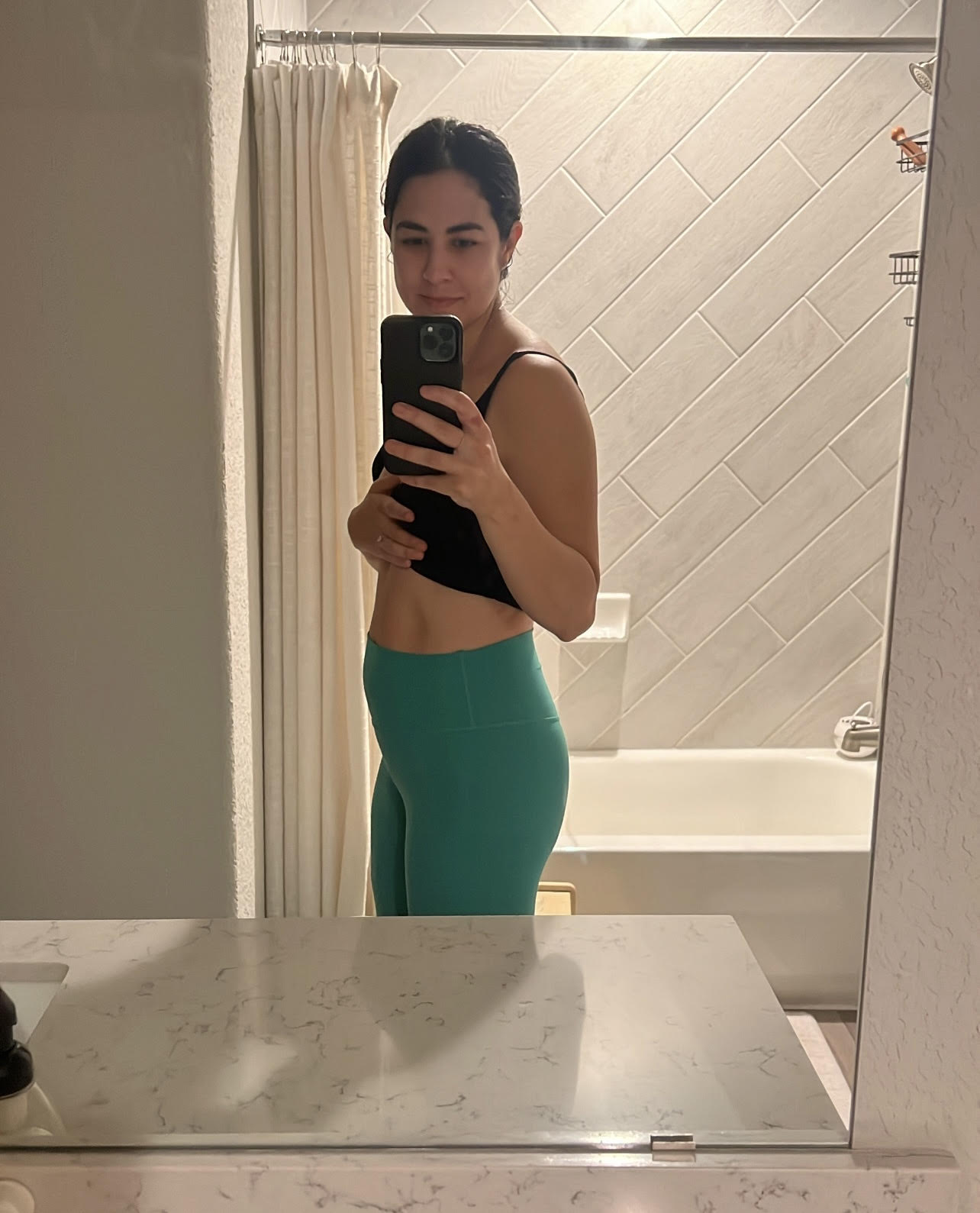
10 weeks^
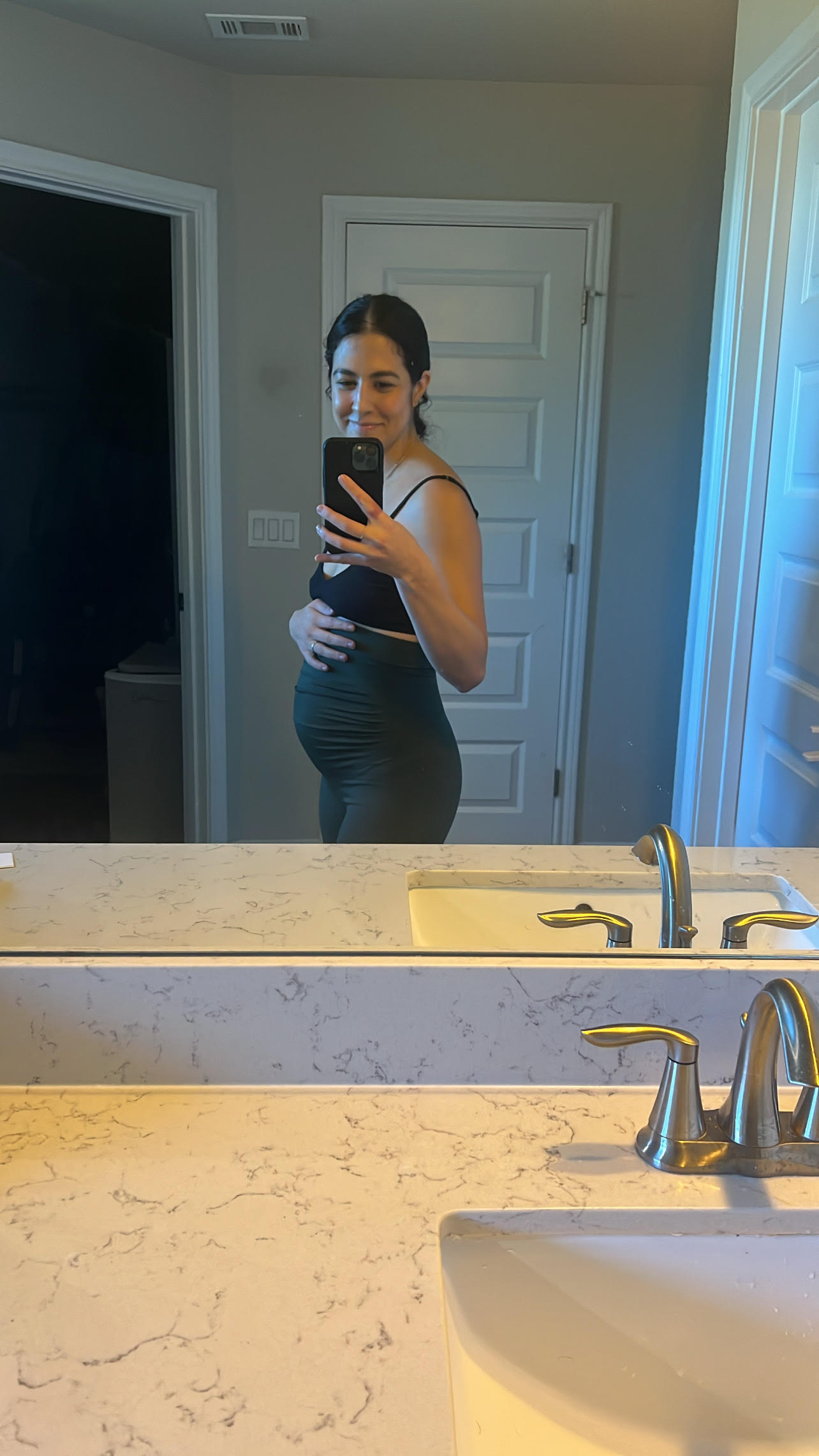
16 weeks^

21 weeks^ (still hadn’t really gained at this point!)

26 weeks^

31 weeks^
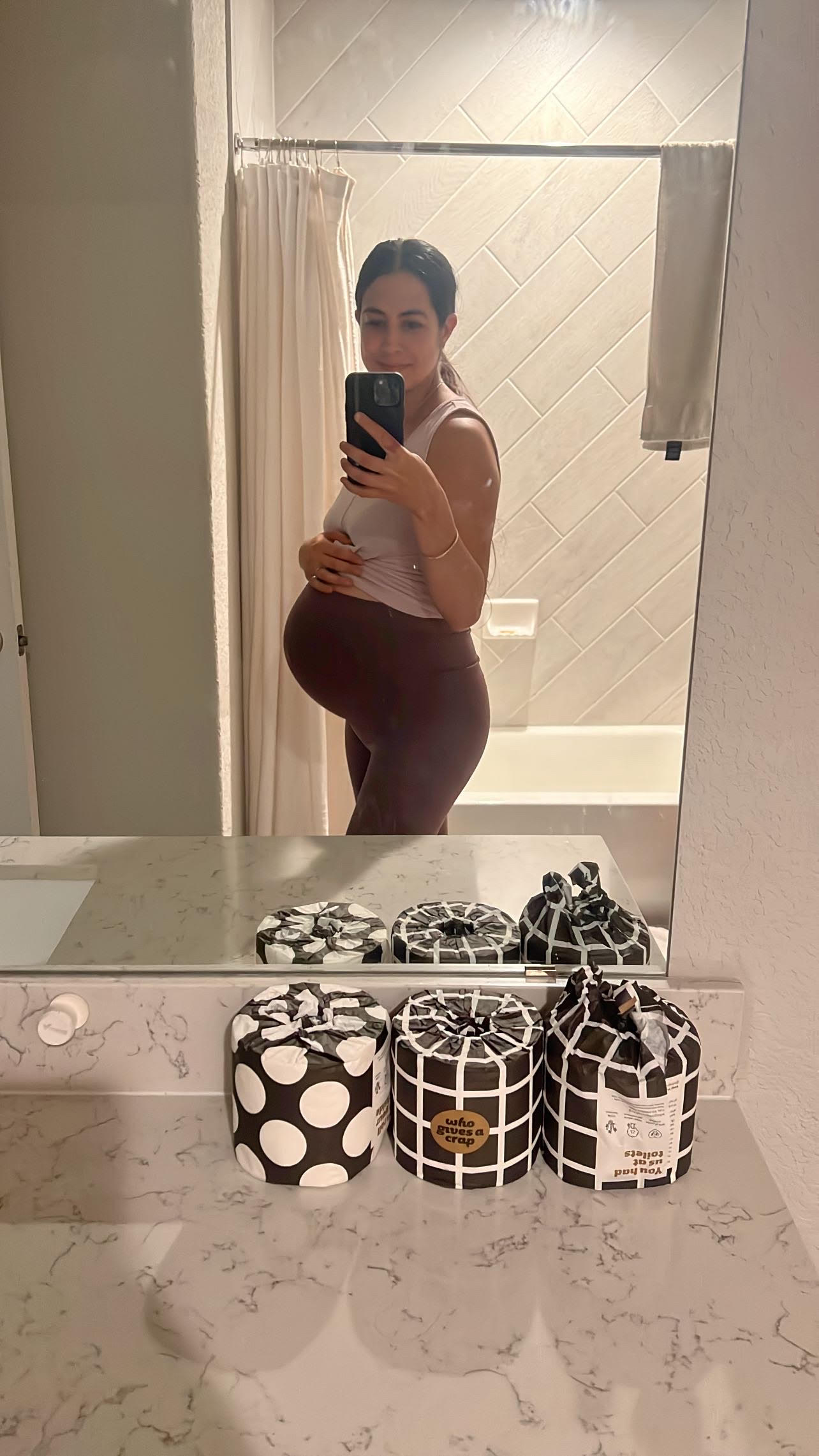
^36 weeks
Since I am not eating raw dairy this pregnancy (and since I ate so much of it last pregnancy), I figure maybe I’ll just gain less weight overall, but we’ll see.
Either way, I am happy to have gained some weight and always celebrate whenever I see the number on the scale go up!
Stretch marks
During my first pregnancy, I used a belly butter lotion on my belly and boobs as soon as I started to show (which was in my second trimester).
I ended up getting a few stretch marks, but they blend in with my skin and you can barely see them.
I did the same thing this pregnancy – started applying belly butter as soon as I began to show (which was way earlier this time, like 10 weeks!).
The little 10-week bump. 🙂
I switched belly butters since the one I used last time was no longer available.
I now use MotherLove belly salve and love it. I don’t think I’ve missed a day – partly because I would love to not get any new stretch marks, but also because the belly butter is so decadent and I’ve loved making it a part of my evening post-shower ritual.
I have also heard that consuming collagen regularly can help with stretch marks.
Unfortunately I can’t do this right now as I am highly sensitive to collagen due to it’s histamine content, so I’m doing what I can with the belly butter.
So far at 31 weeks, I don’t seem to have any new stretch marks. But I didn’t see the ones from my first pregnancy until after birth, so we’ll see what happens after birth with this one. animal based pregnancy
Pelvic floor
My prolapse/pelvic floor symptoms showed up much earlier this pregnancy. I actually felt them in my first trimester.
My core symptoms were/are:
- heaviness in my vagina
- leaking pee randomly
- urgency to pee frequently
- only peeing a little bit despite feeling an intense need to go (this is not chronic, but happens here and there)
- it takes a while for the stream of urine to start despite feeling an intense need to go (this is not chronic, but happens here and there)
- constipation
I would also sometimes void my entire bladder (oof) while vomiting, which was not fun.
At the beginning of my second trimester, I decided I didn’t want to go into birth with these symptoms, so I started focusing on strengthening my pelvic floor.
My symptoms have improved greatly, I have many symptom-free hours/days, and overall, my pelvic floor just feels way stronger.
I saw a pelvic floor PT a few months after my first daughter’s birth because I was experiencing the above symptoms. I actually experienced them during my first pregnancy, but just thought they were normal and didn’t do anything about it.
When they didn’t resolve after birth (and actually got a bit worse), that’s when I sought out a pelvic floor PT.
She diagnosed me with a grade 1 bladder prolapse (which I honestly think I had even before pregnancy) and gave me some exercises to do to strengthen my pelvic floor.
She mentioned I had a great brain-pelvic floor connection and that I had good awareness of my muscles when prompted, I just had to practice more and integrate this connection and awareness into functional daily movements.
So I committed to the exercises and did them regularly. I found complete relief, which was great! animal based pregnancy
So when I experienced the symptoms again this pregnancy, I pulled out her plan, added a few more exercises, and made a new plan that I did as often as I could.
The plan consisted mainly of:
- diaphragmatic breathing
- transverse abdominis bracing in multiple positions
- other miscellaneous pelvic floor strengthening exercises I found online (there are a ton on YouTube, I love MamasteFit)
Also, if you’re looking for a structured program that is reasonably priced, True Core Health with Adelaide Meadow is great. I did it for a month and took a lot from it.
Pelvic floor exercises are so simple and you don’t need to do them for long…just a few minutes each day.
They’re so simple and brief that you’d think they don’t work, but they totally do if you’re consistent.
In just learning how to do diaphragmatic breathing and transverse abdominis bracing alone (and then doing it throughout my day, like when I switch positions, lift something, etc.), I saw great results.
Labor prep
Aside from the mental prep/birth trauma/shadow work processing that I’m doing internally, I also plan to do the following:
- Red raspberry leaf tea consumption: 1-2 cups/day starting at 32 weeks*
- Continue with eating 2+ Medjool dates per day**
- Pelvic floor exercises
- Diaphragmatic breathing
- Hip stretches, foam rolling, rolling my feet out with the lacrosse ball (more on this in the below “body work” section)
- Birth ball + peanut ball work
*During my first pregnancy, at 36 weeks, I upped my red raspberry leaf consumption to 3 cups per day. During weeks 34-37, I had a massive fear of going into preterm labor. Not totally sure where it came from as I had a great pregnancy without any risks or complications, but it really messed with my head. At the end of week 35, a stressful event occurred. During weeks 35-36, I started to get more contractions than usual. While the contractions could have been caused by other things like stress or dehydration, I learned that for some women, the red raspberry leaf tea can bring them on too. I had a scary experience one night during week 36 (oddly enough, the day before this experience, I accidentally left my tea steeping for 1.5 hours – oof) with contractions that came every 5-10 minutes for hours. It happened immediately post-sex, so the contractions made sense, but the experience really got to me (I thought I was going into preterm labor) so I stopped taking the red raspberry leaf tea. Within a day or two, I was barely getting contractions and felt better overall. My stress also leveled out, so that could have played a role too. I started up with the red raspberry leaf tea again at 37.5 weeks, and drank it up until birth and had a quick, smooth, and uncomplicated labor and delivery (read more about it here, if interested). I really think the red raspberry leaf helped. animal based pregnancy
**I am currently trying to add 1 date/day into my diet. I sometimes get histamine symptoms with dates, so I’m not sure if this will stick. Still trying to figure this out as I ate dates last time and I think they helped my labor. animal based pregnancy
Books
There is nothing like a good book that speaks to a part of you that needs nourishing or growth at exactly the right moment. Many of the below books were just that for me during my first pregnancy. Reading them transformed me in a way that I did not know I needed.
I particularly enjoyed Spirit Babies, Birthing from Within, Labor like a Goddess, and The Nourishing Traditions Book of Baby and Child Care, but all of the below books helped me with my pregnancy (and helped me prepare for labor, birth, and motherhood) in one way or another.
- Spirit Babies by Walter Makichen
- Labor Like A Goddess by Alexandria Moran & Lauren Mahana
- Become the God so She Can Labor Like A Goddess (for partners) by Alexandria Moran & Lauren Mahana
- Birthing from Within by Pam England & Rob Horowitz
- The Nourishing Traditions Book of Baby & Child Care by Sally Fallon Morell and Thomas S. Cowan, MD
- Anti-D Explained by Dr. Sara Wickham
- The Fourth Trimester by Kimberly Ann Johnson
- Home Birth on Your Own Terms by Heather Baker
- The Birth Partner by Penny Simkin & Katie Rohs
- Real Food for Pregnancy by Lily Nichols
I read through a few of them again this pregnancy to get a refresher on the knowledge. animal based pregnancy
Below is a new book that I will be starting in a couple weeks to help prep for birth (so excited!):
- Portal by Yolande Clarke
I also plan to read The First Forty Days by Heng Ou before birth.
I purchased and skimmed through Ina May’s Guide to Childbirth earlier in my pregnancy as well. I didn’t come across much that felt new or revolutionary to me, but many people swear by this book.
Body work
Because my body had been feeling so worn down, my pelvic floor symptoms showed up way sooner, and overall, I just felt tight and frozen most of the time, I felt called to do some body work this pregnancy.
This was a big leap for me as I have a general aversion to practitioners, and unless I deem it absolutely necessary (like the pelvic floor PT post-birth), I do not see practitioners.
But I felt called to try chiropractic care.
I found a local nervous system-focused chiropractor and got some scans done.
The process was interesting!
The chiropractor did three scans:
- one that checks my autonomic nervous system function/HRV
- a thermal scan that checks for inflammation in my spine
- a scan that checks for neural inflammation/exhaustion in associated organs + spinal symmetry
Here are the scan results: animal based pregnancy
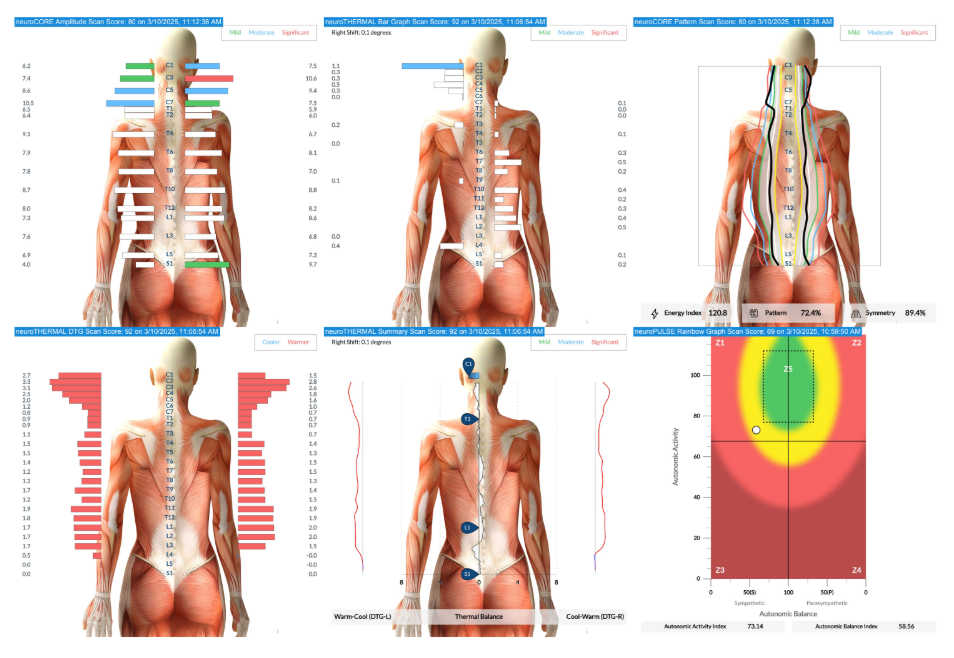
I was surprised to discover that my spine, overall health, and autonomic nervous system function are not in bad shape.
Scan 1 – Autonomic Nervous System Function/HRV (bottom right photo): Note the little white dot. That’s my current placement.
Since the dot sits farther to the left, I am sympathetic dominant (no surprise there).
My HRV was 73, which is pretty decent for my level of stress, chronic sleep deprivation, and the stress of pregnancy.
Ideally the chiropractor wants to see an HRV over 80, but he seemed impressed with my score of 73 given my current stress levels, the chronic sleep deprivation, and the stress of pregnancy.
His assistant also told me something that stuck with me – you may feel stressed all of the time, but how you’re processing and dealing with that stress (or not) matters greatly.
I do a lot of emotional processing regularly, so this made me feel optimistic.
Scan 2 – Inflammation in Spine (top and bottom middle photos): The top middle photo is the one the chiropractor assessed for this category.
As for color, ideally you want to see white. White means no inflammation, green is mild, blue is moderate, and red is severe.
So, based on the graph, I have moderate inflammation in C1 (which is tied to the vagus nerve and autonomic function – so no surprise there), but no inflammation elsewhere. I was pleasantly shocked to learn that.
Also, ideally you want to see the bars trickle down the spine in an “S” curve, so no “bunching” of bars. Bunching points to tension patterns, like if you’re holding tension on your right side or left side in a certain area.
An example of a tension pattern for me is T10-L2. Based on the scan, I do have some tension patterns in multiple areas of my spine.
Scan 3 – Inflammation in Associated Organs + Spinal Symmetry (top right + top and bottom left photos): As for the top right photo, the colors work in the same way that I explained above. White means no inflammation, green is mild, blue is moderate, and red is severe.
So according to the scan, I have the most exhaustion in my neck and sacrum, which are actually the two areas that give me the most issues.
As for the bottom left photo, red is “good” (you want warmth) and blue signals exhaustion. You also ideally want the bars as long as possible. The shorter the bars, the more exhaustion your system is holding in that area.
So from the scan, you can see that I have mostly red which is good, but the last three vertebrae (L4, L5, S1) are blue and have almost no bars. This signals chronic exhaustion.
Each vertebrae is linked to different organ systems and symptoms.
What’s interesting is that the vertebrae that show chronic exhaustion are linked to the reproductive system and digestive system – two systems that I’ve had the most trouble with physically, mentally, emotionally, and spiritually…for years.
Also, I hold physical pain and tension in my hips and sacrum, so this made a lot of sense.
As for the top left photo, my symmetry is 89.4%, so I’m fairly symmetrical according to the chiropractor (good news), and my pattern score was 72.4%, which indicates my current nervous system reserves. I don’t fully understand the latter number because I’m not sure how much reserves a person “should” have, but the chiropractor mentioned that based on all of the tests he runs, it wasn’t a horrible number.
Adjustments
The scan results were exciting to receive, and it was encouraging to get some validation that my body was not in horrible shape – at least according to these scans – as I head into birth.
I got a few adjustments which deepened my overall body awareness and pointed me to areas where I’m holding a lot of tension (neck, glutes, and hips, mainly).
I put a pause on adjustments and plan to focus on carrying out the rest of my pregnancy myself at home with hip stretches, myofascial release on my glutes with the lacrosse ball, full-body foam rolling, and rolling out my feet at night with the lacrosse ball.
A note on rolling out the feet: one of my friends did this religiously for about 5 minutes per day before bed during her second pregnancy.
She swears it helped her so much, and she ended up having an 80-minute uncomplicated labor with a much better recovery than her first (and she attributes this partly to rolling out her feet regularly).
I started doing this a few weeks ago, and it feels so amazing. It’s a “hurts so good” feeling, and it has become a part of my evening routine.
What’s even more interesting is that when I started the practice, my inner arch was super sensitive whenever I rolled over it. I looked up a foot reflexology chart, and that area specifically is linked to the adrenals!
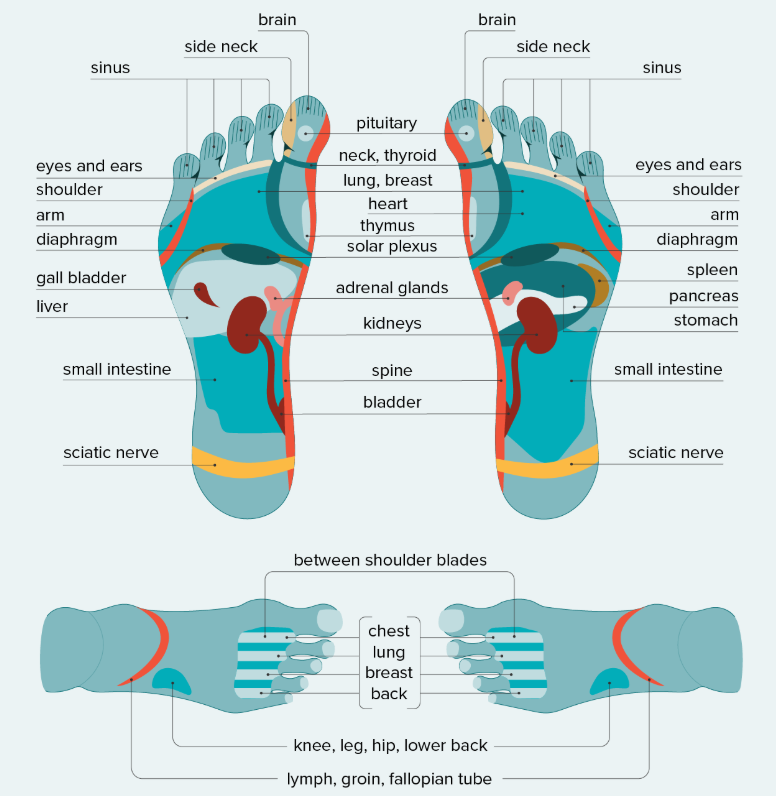
Source: https://www.healthline.com/health/foot-reflexology-chart
Now that I regularly roll out my feet, the area doesn’t feel as sensitive. I also think the feet-rolling has helped my sleep and overall well-being, so I plan to continue the practice until birth, at the very least, and probably beyond. animal based pregnancy
General movement
Between multiple outings per week with my toddler and chronic sleep deprivation/stress, I’ve felt pretty worn out this pregnancy and can rarely find the energy or desire to do movement other than what I already do.
I’m on my feet most of the day (which feels okay most of the time), but aside from that, whenever I have excess energy, I do hip stretches, roll out with the foam roller/lacrosse ball, or sit on my yamuna ball.
Occasionally, I go for walks too.
I wish I could do more, but I’m also trying to honor my body where it is at given my current load. I don’t want to push things too much, especially near the end of pregnancy.
Rh- thoughts
I wrote about this in the blog post about my first pregnancy, but thought I would include the excerpt here again.
I am O- and my husband is A+. animal based pregnancy
Since my husband’s dad is A- and his mom is B+, my husband holds one Rh- allele from his dad and one Rh+ allele from his mom. Since I am O-, I hold two Rh- alleles from both of my parents.
Given this info, my husband and I have a 50% chance of having an Rh+ baby.
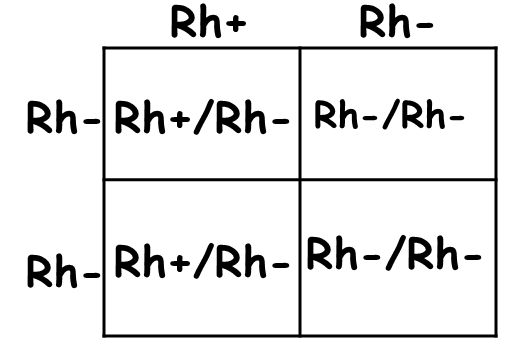
If you would have asked me at the beginning of my first pregnancy about the RhoGAM shot, I would have told you that if my daughter ends up being Rh-, I wouldn’t get it, and if she is Rh+, I will.
But as I looked into the shot, my hesitation grew. My mom gut told me something didn’t feel right about it.
I don’t love that it is a human blood product (sourced from thousands of donors) and that it comes with pathogenic risk. The thought of getting injected with the blood of thousands of human beings I don’t know really irks me. And considering the pandemic, donors could be vaccinated, but there is no way to tell for sure…another irk.
On the flip side, if I didn’t get the shot, there is a risk of becoming sensitized to the Rh+ protein and harming future pregnancies.
Because both sides held what felt like extreme risk, my internal compass did not point strongly toward either.
I joined the Facebook group RhoGAM Rebellion and read personal accounts from moms. animal based pregnancy

The stories were all over the map.
Some got the shot, and… animal based pregnancy
- believe it saved their future pregnancies
- still became sensitized (even with both the pregnancy and post-birth shot)
- were injured from it
- believe it injured their children
Others didn’t get the shot, and… animal based pregnancy
- had a home birth with no interventions and still became sensitized/had problems with future pregnancies
- birthed plenty of Rh+ babies and never became sensitized or had any problems with future pregnancies
- birthed plenty of Rh+ babies, became sensitized, but never had any problems with future pregnancies
These stories didn’t clear things up right away, but they did demonstrate that the shot is not as effective as I once thought it was. So even if I got it, it may not work.
I also learned that some moms never got the shot, had no problems, and had plenty of healthy babies. So if I didn’t get it, maybe I’d be just fine.
The following podcast, books, and IG video gave me what I personally needed to make my decision. There is no alternative to getting the RhoGAM shot and it does not come without risk, but if you are on the fence like I was, I highly recommend checking out the below resources.
Podcast:
- Gestational Diabetes, GBS, Ultrasound Technology, and RH Negative: A New Perspective by The Free Birth Society
Books:
- The Nourishing Traditions Book of Baby & Child Care by Sally Fallon Morell and Thomas S. Cowan, MD
- Anti-D Explained by Dr. Sara Wickham
Instagram:
- IG video on RhoGAM by Holistic RN @lindseytuttlenp
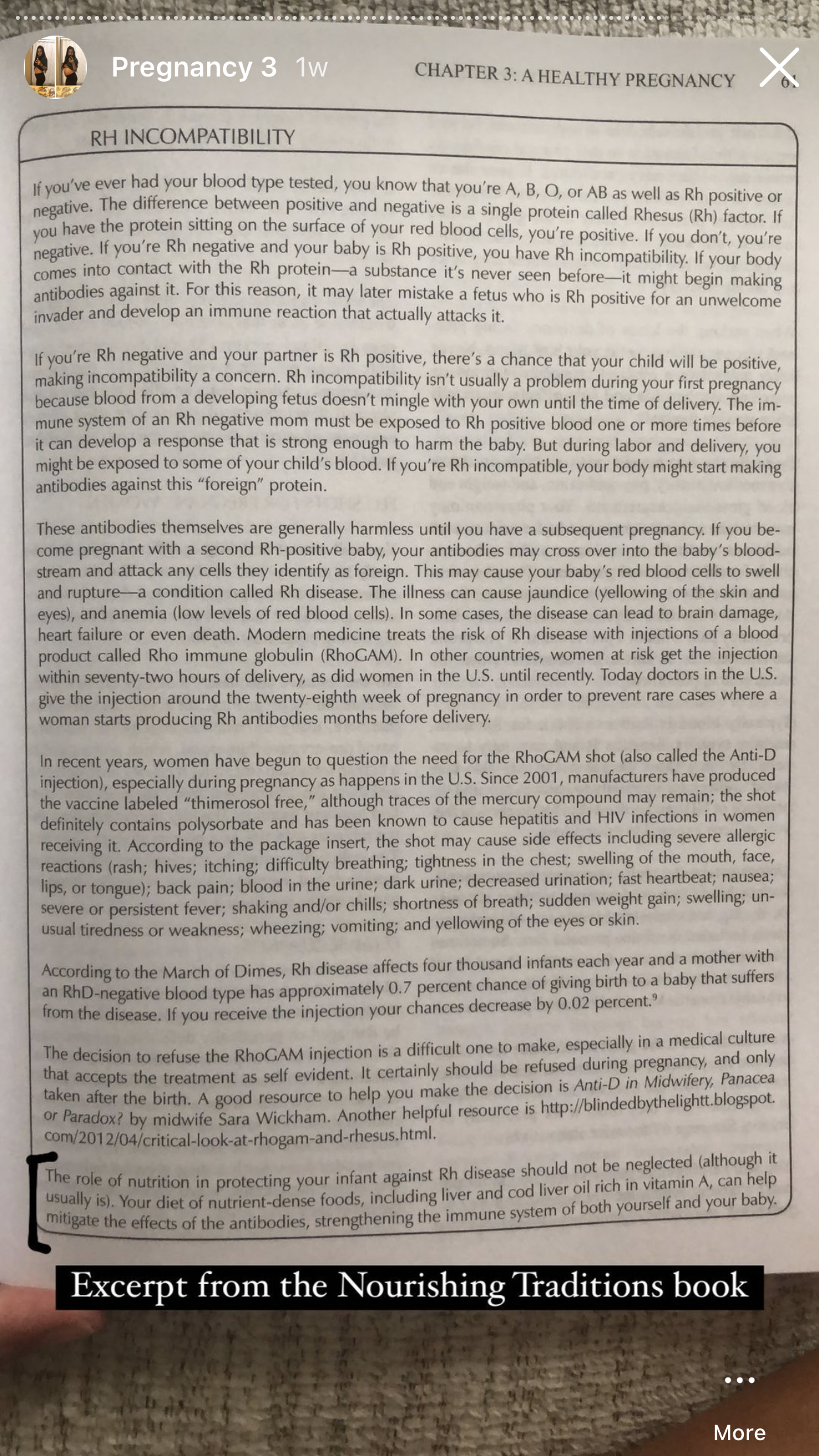
Excerpt on RhoGAM from The Nourishing Traditions Book of Baby & Child Care book
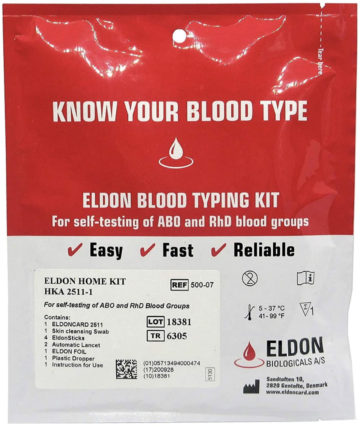
I also highly recommend getting your partner’s blood type checked even if he thinks he knows it. animal based pregnancy
My husband’s mom told me she was 100% certain that he was B+. I ended up testing him anyway to be sure and he is actually A+.
This doesn’t change our Rh situation, but I’ve heard stories of hospitals telling moms their baby’s blood type only to find out years later that it was the wrong one, so you just never know.
I linked a cheap and popular blood type test you can get on Amazon below. animal based pregnancy
With my first daughter, I decided that either way, I would not get the shot. The universe blessed us and she ended up being A-, so there was no risk of me getting sensitized.
I will not be getting the shot with this second baby either (and probably not with any of my children), but we’ll see what blood type this new babe ends up having. animal based pregnancy
Final thoughts
I hope you found some of these thoughts, reflections, and suggestions useful.
I am just over 75% (give or take, of course) of the way through my pregnancy now.
While I am someone who does not love being pregnant, I see the silver lining.
I’ve learned even more about my body, femininity, and spirituality than I ever could have imagined or thought, and the soul growth I’ve experienced this pregnancy has happened at a rate of what feels like warp speed.
It has been painful, to say the least, but so valuable.
Best of luck to you with your pregnancy, labor, birth, and motherhood. animal based pregnancy
If you have any questions, do not hesitate to reach out to me at asheatsgood@gmail.com.
For more animal-based pregnancy, birth, postpartum, and motherhood resources, check out my Pregnancy hub. animal based pregnancy

Ashley Rothstein develops tasty, whole food, animal-based recipes that include a moderate amount of “minimally toxic” plant foods. To fix her own health issues, she bounced around between the carnivore, keto, and paleo diets for a few years. After experiencing and studying each diet philosophy, she learned she feels her best by merging the three and following an animal-based diet. As a glut at heart, she likes to channel her creativity and create meals that are healthy but also satisfy her inner gluttonous spirits.
